How to Organise the Fridge and Freezer — A Practical System
We have looked at ideas to organise our kitchen, how to organise the kitchen counters, shelves and the pantry. Now it is time to dive into the perishables and learn how to organise your refrigerator and freezer.
For those who have read some other pages on this site, I’ll give you 30 seconds to guess.
Yes, correct, we will declutter, clean and organise.
Declutter the fridge
With the fridge, I suggest we go from top to bottom. This way we get gravity to work in our favour.
You can work shelf by shelf or get everything out in one hit; if you opt for taking everything out, then you are in for a larger organising session.
Short small burst – one shelf at a time
A larger organising session (don’t spend more than 3-4 hours) – take everything out of the fridge.
Slow and steady
There are pros and cons for both options. We don’t want to have a kitchen full, an empty fridge and an exhausted organiser. Slow and steady is the key here. Every time you finish one tray, you feel like you've achieved a little.
A big job in one hit
At the same time if you have a Sunday morning to do this (ideally with some help) you can get the job done in one hit and as a reward take yourself out for lunch.
The best time to clear and organise your refrigerator and freezer is before you get new groceries in. I sometimes make it a bit of a sport to see how low I can run the fridge, declutter and clean it before the next load of groceries arrives.
When you remove old items from the fridge
Ask yourself:
Do I still like this item, e.g. that specific sauce at the back of the fridge?
Is there anything I realistically won’t ever use?
Should I finish some items in my cooking this week?
This is a time to be honest with ourselves; yes, we have bought items we aren’t using. Let’s learn from it instead of feeling guilty and remove the item. I like to look at patterns for example did you buy cheeses you don’t like or did you only use some sauces once and forget, you might still have half bottles of the stuff. You can use this awareness next time you shop or cook. If you spend some time here thinking (rather than just doing), this, in turn, can save you time, money, and “fridge clutter”.
You know you are done with decluttering your fridge when there is nothing in there you don’t keep for a reason (you want to eat it in the future).
Clean your fridge
Now it is time to wipe down all the shelves, wash all the fridge containers, where possible maybe take them out. For the crumbs and things, vacuum the fridge; you get some looks, but it is a great way to get those crumbs.
If you have sticky stains that are hard to remove, let the soap and water sit on the stain for a minute. It is amazing how a little patience can reduce the elbow grease by 90%.
What should you clean your fridge with?
Opinions are divided, but vinegar and bicarb work well, as does vanilla spray.
I’ll tell you a funny story. Years ago my husband (when still single) left the house for several months as he would be away for work. He knew how to organise the refrigerator and freezer - take everything out and turn it off. Eight weeks later, he returned to a wall of smell. He had left ice cream in his freezer, which was a full-blown science experiment when he came back. The fridge was placed on the balcony for several days, and vanilla spray saved the day and the fridge; it cleared the smell completely.
Tip: Once you have cleaned the fridge, put some glad wrap on the bottom of the fridge to clean up easily next time (as everything eventually falls to the bottom). An easy way to get Glad wrap to stick to the bottom of your fridge is to make it slightly damp (after wiping it down), and the plastic will automatically adhere to it. If you want to be socially responsible, you can opt for biodegradable plastic wrap.
How to organise your refrigerator
Now it gets interesting, as you should have almost a blank slate to work with.
Where will you place your items and where?
This requires thinking and deliberately testing your placement of things.
In my fridge:
I have taken the crisp drawer out because it is too much trouble to open and close it. It was also a breeding place for science experiments. Now everything is easy to spot, it is cleaner, and the food is fresher as I can actually see it.
In my family, we eat lots of cheese (it is the Dutch background ;-). We don’t have to place all the cheese front and centre as we tend to be motivated to grab it anyway. I place some on the bottom in a container, and the brie/blue cheese on the top shelf, which also takes a few seconds to reach.
Vegetables are easy to access, all in the same see-through containers (the same I used in the pantry). We can grab the container when making lunch or dinner and only put it back if there is still something left.
We have a box with chocolate (of which we eat too much)
On eye height, I keep the leftovers and the berries as these need to be eaten first.
A note on kitchen containers:
I like to use see-through containers, preferably without any colours or coloured lids, as this impacts the sense of organisation. If your lid is fully coloured, it also impacts how well you see what is in the container.
As an exception, some glass containers. We use these because it is easy to store and heat in the oven. The downside is that they don’t have a see-through lid.
I advise against round containers. Rectangular containers are so much easier to stack and take less space in the fridge.
For now, my perfect container is this one
In your fridge:
Ask what your family’s favourite foods are.
What should be easy access (the healthy stuff) and slightly more challenging (favourite snacks).
Can you place certain items on eye height? Which, in turn, will reduce wastage.
Using zones in the fridge
What my examples and questions allude to is the use of zones in the fridge, and only you can decide which zones, how large, and where in the fridge.
You know you have achieved this if you can close your eyes and tell your friend where items are in your fridge and why. In organising speak, you have created homes for each item.
The great thing about zones and homes in the fridge is that it makes it easier to see what you run out of, what you have to cook with, etc. One of the greatest gifts organising provides is its ripple effect. Learning how to organise your refrigerator and freezer is no different. You clean the fridge; this makes cooking and grocery shopping easier and reduces how much you spend. If done well, organising pays the original effort back in dividends.
Using habits
I go on about habits a fair amount when organising. No point putting in all the effort and then not being able to keep up with it. When you have organised your fridge have a good think about how habits can support your organised refrigerator.
Daily routines
What can you do on a daily basis:
In the morning as part of your morning kitchen routine?
Can you add some food into the lunch boxes? Reducing waste.
In the afternoon and evening when snacking is on the agenda?
What needs to be done weekly?
For us, groceries arrive weekly.
This is a great time to:
Take stock of what is left
Do a quick wipe down
See if any older food needs to be added into the next meal or tossed.
How to organise your freezer
In the freezer, we apply the same logic as the fridge: you declutter, clean and organise.
However, there are some differences.
What is the size of your freezer? If it is tiny, then you can get away with cleaning it when it is still on. If you have a large chest freezer, we are dealing with something big! It is better to take it off the electricity, clean it and do this as a larger project.
Declutter the freezer
Take everything out and only place items back if you are going to eat them.
Ask yourself what is working and what isn’t in your freezer in terms of storage.
Clean from top to bottom, remove old items, clean one tray and shelf at a time.
If there are items that you don’t know what they are, you probably should toss them (or defrost and eat a surprise meal tonight). As with the fridge, take this as a learning opportunity: what will you stop buying and doing in future?
Organise the freezer
I find the freezer a challenging space to organise like the fridge there is continuous movement. Sometimes it is hard to remember what you put in there 3 months ago etc.
Some key things when you organise your freezer
Can you add baskets and racks in the freezer to double or triple your space?
The cheap wire racks are fantastic in the freezer as they double your shelf space.
For deep chest freezers, how can you use bigger / smaller boxes to stack on top of each other? Maybe you want to have different colours in a chest freezer: green for vegetables, pink for meat and blue for fish.
Ask yourself how you will label?
You could colour-coordinate and put easy tape with labels.
A key with labelling is: will this storage solution last for a long time, or is it one-off?
Having painter’s tape and a black marker in the kitchen is really handy to keep your freezer organised.
Shelve your frozen items.
A great way to get much more in your freezer is using the zip-lock plastic bags and freezing meals or items like “sandwiches” This will allow you to stack meals in your freezer, as they will all be frozen in the same shape. I will freeze something let it rest on the lid of an organising box once it is frozen in the shape I like I can literally file the meal or food.
How much will you freeze and for how long?
If you are new to freezer organising start simple with frequently used foods (cooked pasta, rice, frozen fruit and vegies) and work your way up. Don’t store things you will never eat and don’t like; only store things you really enjoy. This way you will search through your stash on a regular basis
If you want to start experimenting, maybe purchase bread or meat and divvy/cut it up. In containers and zip-lock bags (this way you can see you have bread and meat for a set number of weeks or months).
The principles of organising won’t change. Think about your needs, find a home for your item in this case frozen food, and test if it works. Now you know how to organise your refrigerator and freezer; maybe work on them between 1 and 4 times a year (yearly or quarterly) and note improvements over time.
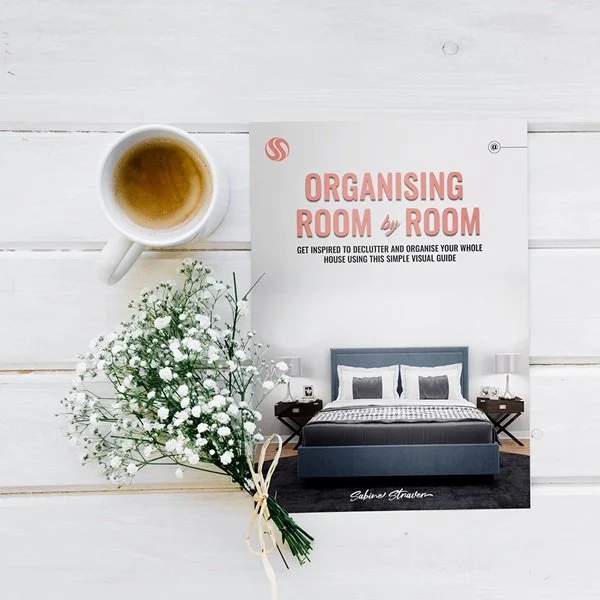
If this resonates
Organising Room by Room walks you through every space in your home — including the kitchen — with the same practical, zone-based thinking.
Frequently Asked Questions
How do I organise the fridge?
Start by decluttering top to bottom — remove anything expired, unused, or unwanted. Clean the shelves and containers, then set up zones based on how your household actually eats: easy-access spots for daily favourites, eye-level for items you need to use up first.
What's the best way to organise fridge containers?
Use see-through, uncoloured containers so you can spot what's inside at a glance. Rectangular containers stack better and use less space than round ones. Reserve glass containers for items you'll reheat directly.
How often should I clean out the fridge?
Weekly works well for most households, ideally timed just before your next grocery delivery or shop. This naturally forces a review of what's left, what needs using up, and what can be tossed.